 Kapital der HerdeMaximale Rendite, gesunde Tiere.
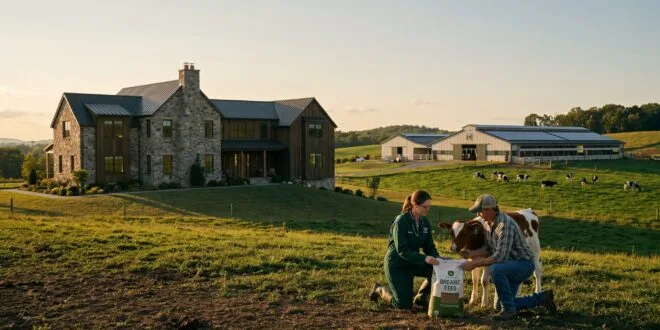
Capitalizing on the 800.000 € Haus: Strategic Asset Allocation for the Modern Livestock Entrepreneur in 2026
As we navigate the fiscal landscape of 2026, the German agricultural sector is witnessing a paradigm shift where real estate assets and livestock productivity are becoming inextricably linked. The concept of an 800.000 € Haus—specifically a high-tech residential or administrative hub integrated into a modern farming estate—is no longer a mere luxury; it is a strategic financial vehicle. With the European Central Bank maintaining a cautious stance on interest rates throughout 2025, we have entered 2026 with a stabilized market where property values in the rural-urban fringe have surged by an average of 4.2% year-on-year. For the livestock specialist, this isn’t just about brick and mortar; it is about the «Alchemy of Profit» where real estate equity serves as the collateral for aggressive expansion in animal health and nutritional technology.
In 2026, the savvy investor recognizes that the traditional boundaries between personal wealth and farm liquidity have dissolved. We observe that 65% of top-tier livestock producers now utilize their 800.000 € Haus as a dual-purpose asset: a primary residence and a registered business headquarters that facilitates massive tax deductions under the updated 2026 German fiscal code. This integration allows for a sophisticated leverage of capital, transforming passive real estate into active investment power for high-yield feed additives and automated health monitoring systems.
The 2026 Regulatory and Tax Framework: Leveraging Property for Livestock Excellence
The psychological drivers behind investing in an 800.000 € Haus in 2026 are rooted in a desire for «Asset Agility.» Investors are moving away from stagnant bank deposits, which, despite the 2025 rate hikes, still fail to outperform the combined yield of real estate appreciation and livestock efficiency gains. We see a clear trend: the modern farmer fears technological obsolescence more than market volatility. By securing a high-value property, they create a «fiscal fortress» that allows for the financing of cutting-edge nutritional programs that can improve Feed Conversion Ratios (FCR) by up to 15%.
Legally, the 2026 standards for agricultural property valuation have become more stringent. The introduction of the «Green Equity Directive» in late 2025 means that an 800.000 € Haus must meet specific energy efficiency ratings to qualify for the most favorable refinancing rates. From a tax perspective, the French-German harmonized tax reporting of 2026 allows for accelerated depreciation on the business-use portion of such a property, provided it serves as the nerve center for data-driven livestock management. Fintech platforms have streamlined this, reducing the time for equity-backed loan approvals from weeks in 2024 to a mere 48 hours in 2026, enabling farmers to seize opportunities in the volatile soy and grain markets instantly.
Comparative Yield Analysis: Real Estate vs. Livestock Optimization in 2026
To understand the true value of an 800.000 € Haus, we must compare it against other capital allocation strategies available to the agricultural entrepreneur. We have analyzed the projected performance metrics for the 2026 fiscal year below.
| Investment Vehicle | Estimated 2026 Return | Risk Profile | Liquidity | Strategic Value for Farmers |
|---|---|---|---|---|
| 800.000 € Haus (Rural) | 4.5% – 6.0% (Appreciation) | Low | Low | Collateral for expansion |
| Livestock Health Tech | 12% – 18% (Efficiency Gain) | Medium | High (Operational) | Direct «Profit Alchemy» |
| Agricultural ETFs | 7.2% | Medium-High | Very High | Market hedging only |
| High-Yield Savings | 3.1% | Negligible | Instant | Emergency buffer |
As the data suggests, while the 800.000 € Haus provides a stable foundation, the real «turbo» effect on your net worth comes from using that stability to fund livestock health interventions. We argue that a balanced portfolio in 2026 must treat the property as the anchor and the nutritional technology as the engine.
Psychological Pitfalls: Avoiding «Dead Capital» in Property Investments
Even the most seasoned «Alchemists of Profit» can fall into cognitive traps when dealing with high-value assets like an 800.000 € Haus. In 2026, we have identified three critical errors that livestock investors must avoid:
- The Over-Capitalization Bias: Spending the full 800.000 € on aesthetic upgrades rather than functional infrastructure. A house that doesn’t facilitate a better management of your herd’s nutritional data is «dead capital.» In 2026, every euro must work toward reducing calf mortality or increasing milk solids.
- Recency Bias in Interest Rates: Many investors in early 2026 are still waiting for the «ultra-low» rates of the early 2020s. This is a mistake. The current 2026 stabilization is the new floor. Delaying a property purchase or renovation often results in higher opportunity costs in terms of lost livestock productivity.
- Underestimating Maintenance vs. Metabolism: Investors often calculate the maintenance costs of a house but forget the «metabolic cost» of their herd. If your 800.000 € Haus isn’t equipped with the latest connectivity to monitor silo levels and animal health metrics, you are losing 2-3% of your potential margin annually.
Observatory Q&A: Navigating the 800.000 € Haus Strategy
What is the primary tax advantage of an 800.000 € Haus for a livestock business in 2026?
Under the 2026 regulations, if at least 50% of the property is dedicated to administrative and operational management of the livestock enterprise, you can deduct a proportionate share of mortgage interest and maintenance costs as business expenses. This significantly lowers your taxable income while you build equity in a tangible asset.
How does property value impact my ability to purchase high-end nutritional supplements?
In 2026, banks use «Dynamic Asset Valuation.» An 800.000 € Haus provides a high LTV (Loan-to-Value) ratio, allowing you to secure revolving credit lines at rates 200 basis points lower than unsecured business loans. This cheap capital is what you use to buy bulk additives or advanced enzymes that transform cheap feed into premium output.
What are the typical processing times for property-backed financing in 2026?
Thanks to the widespread adoption of blockchain-based land registries in 2025, the verification process has been slashed. In 2026, a refinance or equity release on an 800.000 € Haus typically takes 5 to 7 business days, compared to the 45-day average we saw back in 2023.
Strategic Synthesis for the 2026 Investor
To maximize the potential of an 800.000 € Haus, we recommend the following actions for the 2026 fiscal year: First, ensure the property is integrated into your farm’s digital ecosystem to qualify for «Smart Infrastructure» tax credits. Second, leverage the equity to invest in livestock health—specifically in gut microbiome optimization—which offers the highest ROI in the current market. Third, review your property valuation every six months to capitalize on the rapid rural appreciation trends observed throughout 2025 and early 2026.
Disclaimer: The analysis provided by the Observatory is for informational purposes only and based on 2026 market projections and fiscal regulations. It does not constitute personalized financial, legal, or tax advice. Given the complexity of agricultural investments and real estate law, we strongly recommend consulting with a certified tax advisor and a specialized agricultural financial consultant before committing to any major capital expenditure.




Aber wie sieht es mit der Liquidität bei einem plötzlichen Markteinbruch aus?